Friday, July 16, 2010

Potato Tending

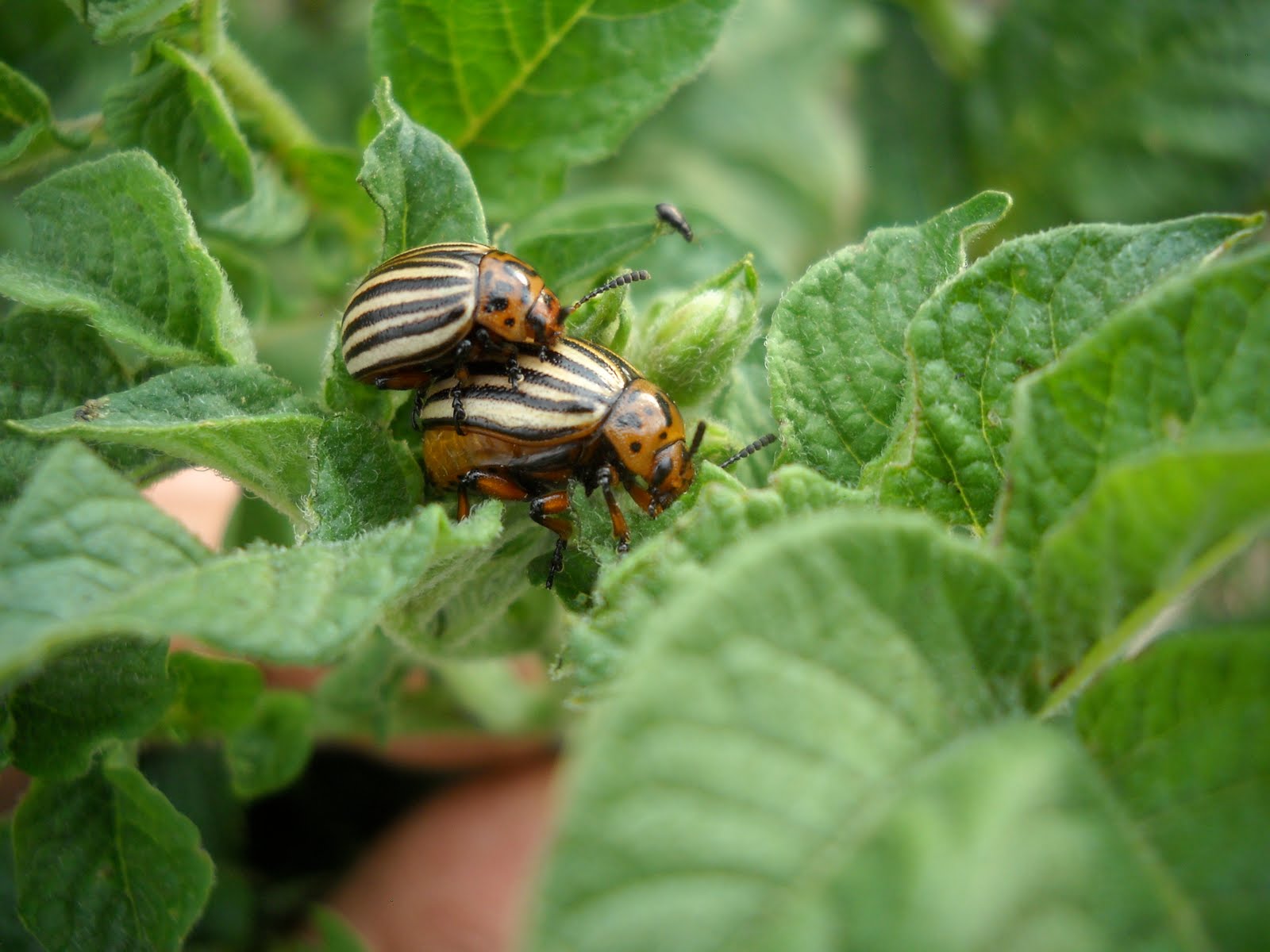
Ha, fruitless potato beetle fornication; they're dead

Today I finally 'hilled-up' the fingerling potatoes planted in late May. Potatoes grow new tubers off of lateral shoots coming off of the stem growing from the seed potato, and burying the lower portions of the green foliage is a requisite for a good potato harvest. Or so I've read. It provides more stem/branch intersections from which to grow new potatoes sheltered from the bitter alkaloid forming effects of sunlight.
Dark mounds of top-soil prior to tilling and hilling

I planted these potatoes late, and I'm probably hilling them up a little late too. Spending more time with the spuds, I also noticed and killed a half-dozen potato beetles. They make a loud crunch between two rocks and lay these day-glow orange eggs on the bottom of leaves. They squish rather than crunch.
Cultivating between rows of buried 'taters

I planted these potatoes in rows that were a little too raised above the surrounding soil. I've had to add a cheap sandy top-soil mix, tilled with the native clay soil, to the inter spaces between the rows in order to have enough soil to pull up and over the lower portion of the growing stems. The new tiller with a 17" wide tiller box fits perfectly between the rows and makes easy work of the compacted clay.

Who left the gate open?

So, occasionally we're all reminded of how some people in life have it a hell of a lot harder than we do. I know that's the concept at play when I've lost tillers, turkeys, and wet Carharts to the sometimes sticky, yet needy hands of my neighborhood. I now lock-up the tiller and raise only chickens. The carharts still hang in the sun longer than they should twice a week.

Is this your boot?
This time I returned home from a few days at the cabin to find an up-turned and trampled 5-gallon container tomato plant. Next to it lay a cell phone charger and a pair of steel-toed boots.? Not knowing the extend of visit, the dogs and a sharp hand-tool preceded me into the house. Nothing. Sweet. Later on, Ricardo from next door politely told me of a stumbling drunk trying to sleep under my motion-sensor lights the previous night that he called the P.C. on. They left his boots behind, and the tomato will be fine.

Tuesday, July 13, 2010

Smoked Trout and Pea Soup

Salt, trout, brown sugar, and water

Ya, so I don't know if these things go together in the culinary world, but it's smoked trout and pea season in my world. The former coming from McGaffey Lake and the latter from my neglected row of peas. This year the trout seem harder than usual to coax into the little blue kayak, most hitting on pheasant tail nymphs as opposed to my tried-and-true sparkly wooly bugger. All home-tied.
Sans skin after smoking, alternating fat and flesh

With the help of a couple generous strangers at the lake and a couple days catch, I finally had a half-dozen foot-long trout ready for the electric smoker at our Cabin 34. After 5 hours of wet brine (salt and brown sugar) and 5 more hours of intermittent alder smoke at 140 degrees, the trout were transformed into late-night lox.
Shucking Peas

The pea-soup was the first I'd made from fresh peas, and despite two people with two open computers at the cabin, the recipe was entirely off the top of our heads; free of on-line help. I sauted garlic in butter, added chicken stock, cubed potatoes, and the bowl of shucked peas. Water plus moderate heat for 5 hours, covered, and we had fresh and tasty pea soup. Perfect on a stormy monsoon afternoon.

The only thing better than the fishing at McGaffey is the mountain biking trails; IMBA TrailCrew visits Cabin 34

Saturday, July 10, 2010

Farmers' Market Season is Here!

My baby Italian cocozelle with flowers on the way to the market

The Ramah Farmer's Market started several weeks ago, and Gallup's Farmers' Market began this past Saturday, July 10th. The market in Ramah is the larger of the two with 1-2 dozen craft and produce vendors, and very active group of volunteers. It's easy to keep up with the numerous events and resources in the Ramah area by reading their bi-monthly newsletter, The Ramah Farmers' Beet. At the height of the harvest season in August, the RFM attracts 350+ visitors/day. My favorite items from there are Windy Ridge goat cheese (look for the lovely Jesse Lee Grey sitting on the south side of the horseshoe with two nondescript coolers behind her table) and the Nolo bait (organic grasshopper-cide) for only $3/pound!!! It runs from 10-1 pm, next to Backwoods Pizza on Ramah's west-end. I'll take pictures next time I head south.

The early shoppers equally splitting up the carrot harvest

In comparison, Gallup's Farmers' Market is no slouch. Sure, it's not as big yet, but each year it is growing and last year's market days had an impressive variety of produce, baked goods, crafts, and information booths. This year's season started on July 10 and will continue through September, I think. A nice addition to the market this year is the Work in Beauty, CSA (Community Supported Agriculture) booth where they'll be distributing CSA shares and selling extra produce.
Cynthia of The Coffee House bought half of that day's garlic

After sleeping fitfully all night in anticipation of the first market day, I awoke around 7 ready to start harvesting, only to see that it was raining. On my list of items to harvest where radishes, large green onions, carrots, purslane, spinach, collard greens, baby zuchinni, male squash flowers, mint, rosemary, and the garlic was already pulled.

Top to bottom: Baby finger, Danvers, Scarlet Nantes

The onions, carrots, and radishes took some time to wash and tie into bundles and so I left home at 8:45 without any purslane, spinach or collard greens in tow:( [Blog editing note: I just saw a Lance Armstrong RadioShack ad that said it's not cool for guys over 30 to use emoticons. WTF, and when did he get so awesome?]

Carole Palmer (market manger) and the sold-out table of Sunrise School for Ecological Living, Fort Defiance, AZ

I'm not sure whether the market officially opens at 8:30 or 9, but when I arrived there was already 2 booths set up and already sold out of their onions. Within 10 minutes I had sold all the garlic and carrots. Get there early! Though, Mrs. Butler generally shows up later (usually 10 ish) with a huge variety of produce (this week she had eggs, turnips, cole-crop starts, and woven baskets benefiting the market). Paul and Mary-loo of the Sunrise School had radishes, greens, pepper transplants, and onions grown by students at their school in Arizona.

The CSA crew in a rare moment of chilling

Here are the prices I settled on: garlic ($1/head); onions (10/$1); carrots in a bunch(5/$1); mixed radishes (10/$1); mint ($1/bunch); baby zucchini and squash flowers (4/$1). By 10:20, I had sold everything and made the most rewarding $45 ever! Of course, it's not about the money; best of all I met many great new people and old friends in that shady walkway downtown. In theme, the best over-head saying of the day was, "I don't spell 'profit' with an f."

The Butlers stand

In all, the first market day of year in Gallup went well. The quantity and variety of produce available will expand greatly over the next month as warm season vegetables come into season. Carole Palmer mentioned the WIC food assistance program will be up and running in a few weeks attracting many low-income and elderly customers to the market. And hopefully some of the usual growers and vendors from the Vanderwagon area will return to the Gallup Farmers' Market, opting for Ramah this week. I'll have a steady supply of onions, shallots, and garlic at my stand each week, in addition to the rotating menagerie of warm season crops coming into season.
Garlic Harvest 2010

That 'root' is wiggling; happy soil, happy plants!
9 months to the day after planting garlic cloves on a warm day in early November, this week I pulled-up my best garlic harvest ever! The soft-neck California white garlic cloves I bought at the La Montanita Co-op to use as seed garlic produced 100 impressively large and pungent bulbs; they're actually as big as store-bought garlic, yet much crisper and more flavorful! Click here to read my November post about planting these.

I had to use a shovel to lift the bulbs intact
After spending the cold-winter establishing their roots, the garlic leaves first emerged in early January. They must be made of anti-freeze....because....well, they didn't freeze on some damn frigid winter nights. In April I gave them a feeding of organic fish emulsion (high in nitrogen for leaf growth). I began consistently watering the two garlic rows in early April. By this point each plant had 8 - 12 leaves and stood 18+" tall, yet if you pulled one to eat as 'green' garlic you'd notice no swollen bulb at the base-- it doesn't start to swell until the summer. As summer approached I selected a couple plants to monitor the bulb growth by carefully removing the soil from around the bulb and checking them periodically. In mid-June, the bulbs were just starting to take shape and I gave the garlic it's last fertilizer, organic mori-bloom with a nutrient content of 0-10-10 (no nitrogen, and lots of phosphorus for bulb growth).

Before rinsing
By late June I reduced the amount of water they received so the soil wouldn't be overly saturated and lead to rotting of the protective white sheath covering the bulb. As the leaves progressively turned brown and shriveled, starting with the bottom-most leaves and then proceeding up the plant, I read everything I could on-line about when to harvest. Most advice on this matter takes one of two forms: either watch the bulbs closely and harvest when there are 2-4 sheaths remaining over the cloves (probably more precise), or , harvest when the top part of the plant (leaves) turn brown. Using the former method, I harvested on July 7th. The upper-most 2-3 leaves on the plants were still green, but the stalks were mostly dry and starting to fall over at their base. The timing must have been perfect because only a couple cloves emerged with their protective sheaths nearly gone (I'll keep all these to eat at home), and all of the others were intact and swollen to their maximum size. I'll sell all of the larger bulbs at the Gallup Farmers' Market this year and cook with the smaller ones.

Topbar Beekeeping Workshop in Ramah, July 17&18


The great people at the Ramah Farmers' Market (Association) have organized another fascinating workshop featuring another of New Mexico's sustainable agriculture super-stars (I missed the Tooley fruit tree workshop in the fall, but read about it in one of the fall issues of the Ramah Farmers' Beet)! For this workshop they've coaxed Les Crowder out of the Rio Grande valley and mountains of northern New Mexico where he frequently offers beekeeping workshops, and he's coming to Ramah on July 17 & 18. Please call Kate Wilson (RFM manager- 783-4704) to sign-up in advance for this workshop; they really need every interested person/couple to attend as they've barely met the minimum number of students that would make the long trip from Rio Lucio worth it for Les. Browse his website at www.fortheloveofbees.com

If you're unfamiliar with topbar beekeeping, it's promoted as a cheaper, simpler, and more natural alternative to the traditional method of using vertically stacked Langstroth hives. For more info on the workshop read the text in the photo above. To read my August 2009 post about beekeeping in Gallup, click here.

Other local bee/honey news: The Gallup YCC planned on expanding Karl's 3 hives to 12 this year with the honey for sale at the Gallup Farmers' Market later in the season. I'm unsure if everything went as planned; earlier in the spring Karl mentioned the bee colonies would arrive on May 19th. Last weekend I also learned from Kate Wilson that the Zuni High School is keeping more than a dozen hives this year and honey may already be for sale at Halona Plaza in Zuni!

Wednesday, June 23, 2010

Bragging about Broccoli

Two of a dozen broccoli heads almost ready for harvest
In my (almost too) densely planted bed of cole crops (cabbage, collards, brussels), the broccoli has done really well this year. In prior seasons I've experienced watching the newly formed flower heads quickly leaving the compact dome we're familiar with from the grocery store, and stretching into elongated stalks each topped with a small yellow flower. They're still edible and delicious, but it does feel really good to finally harvest broccoli that looks like it should.

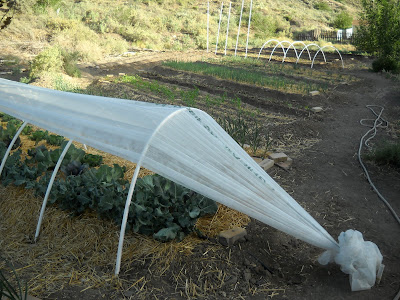
Low-tunnels in use and under-construction
The difference could be a number of factors with the soil, weather, or variety of broccoli but the most likely difference is using the fabric covered low-tunnel to shade the plants during hot days. I bought the dozen transplants from Holiday Nursery (can't recall the variety) and planted them on April 10th. The clay soil in the bed had been heavily amended with manure early that spring.

Frost and White Peaches

A June 8th peach blossom!?!

Catching up with old photos, I had to share the rather amazing site of my White Peach still blossoming on June 8th!!! Even with the rather cold spring nights we've experienced this year, that date is long after most varieties of peaches bloom. Most of which happens too early in the spring and a late frost kills the developing buds or fruit. A caveat though, my White Peach was severely water-stressed this spring and looked like it was dead. Only after realizing how dry the soil was in the small gabion-dam orchard did I give it a ton of water, likely saving the tree and triggering the late bloom.

The first Frost Peach

The more reliable peach variety in this region seems to be the aptly named Frost Peach. This variety is one of three different varieties I bought grafted onto a single trunk. The tree (branch) had numerous flowers well into late May, and in early June had produced this baby peach. If it can survive the phalanx of small finches that inhabit my yard, I'll enjoy my first home-grown peach in couple months. Regarding fruit trees in Gallup, my fingers are almost sore from being crossed so much, but I'm really hoping and wishing for this little sweet summer treat.

Tuesday, June 22, 2010

Hot Summer Days; Cool Summer Nights

Memorial Day tomato planting (40' row)
Summer 'officially' arrived early yesterday morning, though away from the numerical confines of our calendar it seems like our warmest season arrived more than a month ago. It's been hot! But of course, only during the day; Gallup's incredible diurnal shifts (daily difference between the daytime high temp. and night low) have been expectedly dramatic this month and the NWS forecast is calling for a low of 36 degrees tonight!
Arroyo gazing at the tucked-in peppers/tomatoes
This 50+ degree difference plays havoc with warmth-requiring crops like tomatoes, peppers, and cucumbers, and I've had to spend more evenings than I ever expected this month pulling the Agribon-19 floating row covers over the 180' feet of row space planted with this sensitive triad. I primarily chose to grow the Celebrity variety of slicing tomatoes, but I also included a half-dozen each of the large yellow tomatoes and husky red cherry tomatoes, and a dozen Roma plants for canning paste. Jalapenos, Santa Fe Grandes, and Poblanos filled the 30' of space alloted to peppers. The large diurnal shift also has an equal but opposite effect on cool-season crops; cool nights prolong the harvest contrasted with hot days that induce the bitter feeling (and taste) of watching the spinach, radishes, onions, and broccoli start to bolt. Having said that, despite a number of weeks with daily high's in the 90's, most of my cool season crops are still producing a decent harvest every other day or so. The snow peas being the least patient, demanding to be harvested just about every day or they'll quit producing at all. I've also been keeping up with the successional seeding of radishes every week or so, and I am about to start harvesting the 3rd planting. The carrots and shallots are growing well, but I haven't convinced myself that they're ready for harvest yet.
A 25' potato furrow about to be filled with sandy topsoil
At the start of the month I planted the 15 pounds of fingerling potatoes I blogged about earlier in the month, and by now the sprouts have emerged and are 2-4" tall. When most of them reach 5-6" tall I'll mound more soil around them, leaving only about an inch of growth showing. These buried stems are where the potatoes will grow. The potatoes filled 125' of row space, and I still have enough seedlings to plant another 25' row of the buttery and nutty tasting gourmet spuds.

Sorry about the long pause between recent posts; needed a mental vacation. I'll post more details about planting warm season annuals like summer and winter squash, beans, and the cucumbers soon. Also something about the various 6 or more legged creatures that my garden unwittingly sustains, and I'm going to try to keep up with and share the many events going on in the Ramah/El Morro area. Again, thanks for reading.

Wednesday, June 2, 2010

Snow Pea Peas

Pea with flower adornment
After much anticipation and many fretful frigid nights, the snow peas are flowering and more than living up to fecund reputation. The first day I noticed blossoms and peas hanging on the bed planted next to the warming rock wall, I ate all the peas I could find (12) on the spot. Two days later and the same plants I picked clean over the weekend are ready for another harvest.
Spinach ready for a second harvest in less than a week.

Friday, May 28, 2010

Fingerling Potatoes

Chitting in the front window
Potatoes should generally go into the ground around May 1st in this region, but I'm still going to plant a late crop of three different types of fingerling potatoes. They should be ready for the farmers' market by mid-August. Harder to find than regular potatoes (still available @ the Holiday Nursery), I ordered 15 lbs. of the Russian Banana, La Ratte, and Rose Finn fingerling potatoes from Peaceful Valley Farm Supply.
First glimpse of light
They cost the steep price of $4.99/lb, but should return quite a bit of that at the market. After receiving a tightly packed box from the growers in Colorado, I began chitting (pre-sprouting) the potatoes by placing them upright in empty planting trays and exposing them to medium light. Normally you would avoid allowing potatoes to green (the color denotes the bitter alkaloids found in the greenery of all members of the nightshade family), but in seed potatoes it helps them get a quicker start once they get in the ground. Something I need, planting at the beginning of June. I'll plant these in a 25x4' row with 3 sandy soil filled trenches in the natural clay soil of the row. Then I'll try not to overwater them, and fend off the grasshoppers with Nolo bait. Fingers crossed.

Monday, May 24, 2010

Radishes, Spinach, and Onions @ the Co-op

Co-op delivery waiting on the front stoop
Today I learned the Gallup Farmers' market opens on July 10th of this year. Quite a bit later than I was expecting. I was planning on it opening in June so now I'll have a fair bit more produce to sell to the La Montanita Co-op during the early season-- the first snow peas are already flowering. Just in time for a 25 degree night!! Ahhh. Blanket brigade tonight.

I'm getting hung up think months ahead. Just this afternoon I harvested 2.5 lbs of large green onions, 2.5 lbs of bright red radishes, a decent basket of long leaf spinach (oh, it's so sweet), and another ubiquitous basket of baby salad greens. It should be on the co-op shelves by today.

Friday, May 21, 2010

More Spring Greenery

Young Scarlet Nantes carrot

Long leaf spinach planted in early April

Shiitake mushroom left to its own devices

Shallots grow with many more leaves than onions or garlic

Radishes growing amongst the lettuce

Thursday, May 20, 2010

Food Miles

Sadly I drove this basket to market instead of pedaling
Much of the food selection we have available to us at the supermarket is determined by the practical reality of how and when that food gets to the market. I can now empathize a little more with the growers of those thick-skinned cherry tomatoes and unripe bananas. The problem I'd been struggling with was how to get my lettuce to the Co-op in the freshest condition. Cutting lettuce when it's cold (ie. in the early morning) is much preferable to cutting it during the heat of the day (when I get home from work); it won't wilt as quickly and it's sweeter. I generally leave for work by 7 and the co-op doesn't open until 10. Consequently, I was hesitant to bring more to market.

A serendipitous encounter with the manager of the Co-op at the RMCHS Health Fair (I can't believe one of the main attractions is candy at each booth!?!; Gallup Trails 2010 passed out maps instead!) yesterday solved that. Clearly dedicated to providing Gallup with fresh, healthy, local food, she immediately offered to meet me early in the morning several hours before the store opens when hearing of my concern. And so, there I was a few minutes ago in the crisp morning air cutting the first harvest of my baby red and green lettuce mix-- grown under bed sheets at first, and now under the low tunnel. Cutting a 2'x 2' area of the bed nearly filled half of a bushel basket. I'll also bring down green onions and some radishes later this afternoon.

Not surprisingly, I'm not the only one starting to make a few dollars growing food at home. Check out this LA Times article, Backyard gardens become income generators in lean times.